
For most construction work in Iraq, the best choice is an S3 safety shoe or boot. It has a protective toe cap, a puncture-resistant midsole, a water-resistant upper and a cleated, slip-resistant sole.
But one shoe does not fit every job. A steel fixer in Baghdad, an electrician in Erbil and a pipeline crew near Basra face different hazards. Summer heat above 45°C also changes what is comfortable to wear for a 10 to 12-hour shift.
This guide explains which safety shoes suit each construction job, what the safety markings really mean under the latest standards, and which features matter most in Iraq’s climate.
Quick picks: best safety shoes by job
| Job | Recommended type | Minimum rating | Why |
|---|---|---|---|
| General building and structural work | Steel or composite toe boot | S3 | Toe, puncture and slip protection for mixed site hazards |
| Road construction and earthworks | High-ankle safety boot | S3 + HRO | Ankle support on uneven ground, outsole that tolerates hot asphalt |
| Oil and gas projects | Lace-up safety boot | S3 + HRO + SR | Grip on oily surfaces and heat-resistant outsole |
| Electrical work | Metal-free composite toe shoe | EH (ASTM F2413) or electrically insulating rating | Composite toe alone is not electrical protection |
| Indoor fit-out and finishing | Lightweight breathable safety shoe | S1PS or S1P | Lighter and cooler for dry indoor floors |
| Wet trenching and plumbing | Waterproof safety boot | S7 | Fully waterproof with puncture protection |
Shop safety shoes · Shop safety boots · Request a bulk quote
Why Construction Workers in Iraq Need Proper Safety Shoes
Construction is one of the riskiest jobs in Iraq. Workers face heavy materials, sharp debris, moving machinery and extreme heat every day. Without the right footwear, a single accident can mean a crushed toe, a nail through the foot or a serious fall.
| Hazard | What can happen | Feature that protects you |
|---|---|---|
| Falling objects (blocks, tools, steel) | Crushed or broken toes | Steel or composite toe cap (200 J impact) |
| Nails, rebar ends, sharp debris | Puncture wounds through the sole | Puncture-resistant midsole (P, PL or PS) |
| Wet, oily or dusty floors | Slips and falls | Slip-resistant outsole (SR marking for oily floors) |
| Hot surfaces and asphalt | Melting or damaged sole | Heat-resistant outsole (HRO) |
| Live cables and unfinished wiring | Electric shock | EH-rated or electrically insulating footwear |
| Uneven ground and trenches | Twisted or sprained ankles | High-ankle safety boot |
Certified safety shoes reduce these risks, keep you comfortable on long shifts, and help contractors meet site safety requirements.
Safety Shoe Ratings Explained (EN ISO 20345:2022 and ASTM F2413)
Most safety shoes sold in Iraq are certified to the European standard EN ISO 20345 or the American standard ASTM F2413. Check the label inside the tongue, not just the product description.
EN ISO 20345:2022 classes
The standard was updated in 2022. The main changes: slip resistance is now a basic requirement for every class, the old SRA, SRB and SRC markings are replaced by a single optional SR marking, and two new classes, S6 and S7, cover fully waterproof shoes.
| Class | What it includes | Best for |
|---|---|---|
| SB | Toe cap (200 J impact, 15 kN compression) and basic slip resistance | Low-risk work only |
| S1 | SB + closed heel, antistatic, energy-absorbing heel | Dry indoor work, workshops |
| S1P / S1PS / S1PL | S1 + puncture-resistant midsole | Indoor fit-out, warehouses, light construction |
| S2 | S1 + water-resistant upper | Outdoor work in dry conditions |
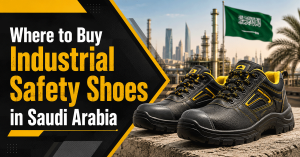
| S3 / S3S / S3L | S2 + puncture-resistant midsole + cleated outsole | Most construction sites |
| S6 | S2 + fully waterproof shoe (WR) | Wet work without puncture risk |
| S7 / S7S / S7L | S3 + fully waterproof shoe (WR) | Trenching, plumbing, wet sites |
Puncture markings: P means a steel midsole. PS and PL mean a non-metal midsole, tested with a thinner (PS) or standard (PL) nail. PS gives better protection against thin nails.
Extra markings to look for
| Marking | Meaning | When you need it |
|---|---|---|
| SR | Extra slip test on tiles with glycerine (oily surface) | Oil and gas sites, workshops, polished floors |
| HRO | Outsole resists contact with hot surfaces up to 300°C | Hot asphalt, roofing, hot work areas |
| FO | Outsole resists fuel oil (no longer automatic from S1 upward) | Oil and gas, vehicle yards |
| WR | Whole shoe is waterproof | Wet sites, trenches |
| CI / HI | Insulation against cold / heat through the sole | Very hot or very cold surfaces |
| M | Metatarsal (top of foot) protection | Heavy lifting, demolition |
ASTM F2413 (American standard)
The base ASTM F2413 rating covers impact (I) and compression (C) toe protection only. Other protection appears as separate markings:
- EH: electrical hazard protection, a secondary barrier against shock in dry conditions
- PR: puncture-resistant sole
- Mt: metatarsal protection
- SD: static dissipative
If a shoe says only “ASTM F2413” without EH or PR, it does not have electrical or puncture protection.
Read more: Understanding Safety Shoe Standards (EN ISO 20345)
Types of Construction Safety Shoes
Steel toe vs composite toe
| Steel toe | Composite toe | |
|---|---|---|
| Material | Steel | Fibreglass, carbon fibre or plastic |
| Protection | Meets the same 200 J impact test | Meets the same 200 J impact test |
| Weight | Heavier | Lighter |
| Heat and cold | Conducts heat, so feels hotter in summer sun | Does not conduct heat, more comfortable in Iraq’s heat |
| Metal detectors | Sets them off | Metal-free models pass through |
| Price | Usually lower | Usually higher |
Both give the same certified toe protection. Choose steel for value on heavy sites, and composite if you want a lighter shoe or work in the summer heat.
Important: a composite toe does not make a shoe safe for electrical work. Only an EH rating (ASTM) or an electrically insulating rating protects against shock.
Safety shoes (low-cut)
Low-cut safety shoes are lighter and cooler. They suit indoor fit-out, finishing work and supervisors who walk the site.
Safety boots (ankle-high)
Ankle-high lace-up boots add ankle support and keep out dust, sand and debris. They are the best choice for most outdoor construction, roadwork and uneven ground.
Rigger boots
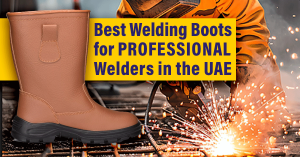
Rigger boots are pull-on boots, popular on oil and gas yards because they are quick to put on and off. Their loose fit gives less ankle support than lace-up boots, so they are not ideal for scaffolding, ladders or uneven ground.
Lightweight sport-style safety shoes
These look like trainers but have a certified toe cap and often a non-metal puncture midsole (S1PS or S3S). They suit long walking shifts on lower-risk sites.
Best Safety Shoes for Each Construction Job in Iraq
Building and structural construction
Masons, steel fixers and carpenters face falling materials, rebar and nails every day. Choose an S3 lace-up safety boot with a steel or composite toe. A cleated sole gives grip on scaffolding boards and loose ground.
Road construction and earthworks
Road crews walk long distances on uneven, hot surfaces. Choose a high-ankle S3 boot with an HRO outsole, so the sole doesn’t soften on fresh asphalt. Good cushioning reduces foot fatigue on 12-hour shifts. Near traffic, add a high-visibility safety jacket.
Oil and gas projects
Sites in Basra, Kirkuk and Kurdistan combine oil, heat and heavy equipment. Choose S3 boots marked HRO and SR, and FO if your site handles fuel. Lace-up boots are safer than riggers for climbing and uneven ground. Read more in our guide to safety shoes for Iraq’s oil and gas industry.
Electrical and MEP work
Electricians need protection from shock, not just falling objects. Choose a metal-free shoe with an EH rating (ASTM F2413) or an electrically insulating rating. Remember that EH protection is reduced when shoes are wet or damaged. For arc flash risks, see our Arc Flash & FR PPE range.
Indoor fit-out and finishing
Tilers, painters and drywall installers work on dry floors indoors. A lightweight S1PS or S1P safety shoe is cooler and more comfortable than a heavy boot.
Plumbing, drainage and wet trenches
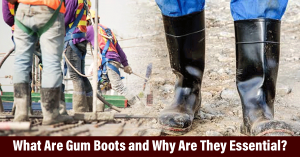
Standing water and mud need a fully waterproof boot. Choose S7 (waterproof with puncture protection) instead of a basic S3, whose upper is only water-resistant. For deep water or slurry, rubber safety gum boots are another option.
Choosing Safety Shoes for Iraq’s Climate
Iraqi summers regularly pass 45°C, with strong sun, dust storms and long outdoor shifts. Heat is not just uncomfortable: hot, sweaty feet cause blisters, fungal infections and fatigue, which leads to accidents.
| Climate challenge | Feature to look for |
|---|---|
| Extreme air heat | Breathable mesh or perforated upper, moisture-wicking lining |
| Hot ground and asphalt | HRO outsole; HI marking for heat insulation through the sole |
| Dust and sand | Ankle-high boot with a padded collar and gusseted tongue |
| Long walking shifts | Cushioned, removable insole and shock-absorbing heel |
| Uneven terrain | Cleated, slip-resistant outsole |
| Occasional wet areas | Water-resistant upper (S2/S3), or WR/S7 for constant water |
Note: HRO does not make a shoe cooler. It means the outsole survives contact with hot surfaces. For comfort in the heat, breathability and a composite toe matter more.
To stay cool on site, pair your safety shoes with breathable socks and a cooling vest.
How to Get the Right Fit
- Try shoes on in the afternoon, when your feet are slightly swollen, like they will be on shift.
- Wear your work socks when trying them on.
- Leave a thumb’s width (about 1 cm) between your longest toe and the end of the shoe. Your toes must not touch the toe cap.
- Check the heel: it should not lift more than a little when you walk.
- Walk, squat and climb a step before deciding. A safety shoe should feel comfortable from day one; don’t expect the toe cap to “break in”.
Safety Shoes vs Regular Work Boots
| Feature | Certified safety shoes | Regular work boots |
|---|---|---|
| Toe protection | Steel or composite toe cap, tested for impact and compression | Usually none |
| Certification | EN ISO 20345 or ASTM F2413 | Not safety certified |
| Slip resistance | Tested on a standard slippery surface | Varies, usually not tested |
| Puncture protection | Available (P, PS, PL or PR) | Usually none |
| Best for | Construction, oil and gas, industry | Farming, hiking, light outdoor work |
Regular work boots are not acceptable on most construction sites.
When Should You Replace Safety Shoes?
On a busy construction site, safety shoes usually last 6 to 12 months of daily use. On lighter indoor work, they may last longer. Replace them immediately if you notice:
- Outsole tread worn smooth, or the sole separating from the upper
- A dented, cracked or exposed toe cap
- A heavy impact on the toe cap, even if no damage is visible
- A nail or sharp object that went through the sole
- Cuts or tears in the upper, or water leaking in
- Insole and heel cushioning that has gone flat
How to Look After Your Safety Shoes
- Clean them regularly. Brush off cement, mud and dust; wipe off oil and chemicals the same day.
- Dry them naturally. Air-dry in the shade, never on a heater or in strong sun, which cracks leather.
- Rotate pairs if you can, so each pair dries fully between shifts.
- Replace insoles when they go flat. Shop insoles and foot protection accessories.
- Inspect them weekly for the warning signs above.
- Store them in a cool, dry, ventilated place.
Common Mistakes When Buying Safety Shoes in Iraq
- Buying on price alone. Cheap, uncertified shoes often have weak toe caps and soles that wear out within weeks.
- Trusting the description, not the label. “Safety shoe” in an advert means nothing. Check for EN ISO 20345 or ASTM F2413 and the class on the tongue label.
- Choosing a composite toe for electrical work. Without an EH or insulating rating, it gives no shock protection.
- Buying heavy boots for indoor work. An S1PS shoe is safer for a tiler than an overheated worker in a heavy boot.
- Ignoring import certification. Footwear imported into Iraq needs a Certificate of Conformity (CoC) under the COSQC program. Buy from suppliers who can provide it.
- Getting the size wrong. Toes touching the toe cap cause pain and black toenails within days.
Construction Safety Shoe Buying Checklist
- Certified to EN ISO 20345 (S1P, S3 or S7) or ASTM F2413
- Correct class for your job (see the quick picks table)
- Steel or composite toe cap
- Puncture-resistant midsole (P, PS, PL or PR)
- SR marking if you work on oily or polished floors
- HRO outsole for hot surfaces and asphalt
- EH rating for electrical work
- Breathable upper and cushioned insole for long, hot shifts
- Correct size, tried with work socks
- Supplier provides certificates and an Iraq CoC for imports
Where to Buy Certified Safety Shoes in Iraq
Protective Wears supplies certified safety shoes, safety boots and complete PPE to contractors and project teams in Iraq:
- Certified footwear: EN ISO 20345 and ASTM F2413 models, with certificates available on request
- Bulk orders: volume pricing for crews, sub-contractors and project stores
- Complete PPE in one order: add safety helmets, gloves and coveralls
- Prices in IQD: switch the site currency to Iraqi Dinar
- Fast quotes: our team replies to B2B requests within 24 hours
Shop safety shoes · Shop safety boots · Request a bulk quotation · Chat on WhatsApp
Related reading: How to Choose the Right Safety Shoes for Iraq’s Oil & Gas Industry
Safety Shoes FAQs
What are the best safety shoes in Iraq for construction workers?
Safety shoes that provide toe protection, have anti-slip outsoles Aand are puncture resistant should be selected by construction workers in Iraq. S3 safety shoes are a preferred type of safety shoes in such a situation.
Are steel-toe safety shoes suitable for all construction work in Iraq?
Steel-toe safety shoes in Iraq are best suited for heavy construction tasks when there is danger of falling or crushing injuries. For electrical or maintenance work, workers might consider using composite-toe safety shoes in Iraq, which are more comfortable.
Are work boots in Iraq ideal for use outdoors on construction sites?
Yes. Good quality work boots in Iraq that have slip-resistant soles, are made of water-resistant material, and offer ankle support are perfect for use outdoors in construction sites.
What safety rating is best for construction safety shoes in Iraq?
Construction safety shoes in Iraq that have a rating of S3 are great to use on most construction sites due to all the protection that they offer.
Can work boots from Iraq be used on outdoor construction sites?
Yes. The high quality of work boots with anti-slip soles, waterproof fabric and ankle protection makes them ideal for use at outdoor construction sites.
Conclusion
It is important to choose the right safety shoes in Iraq that will protect workers from all the common risks associated with construction. It will also increase their comfort at work. The correct choice of safety shoes with certified features will minimize injuries and guarantee efficient functioning in difficult conditions on construction sites. Protective Wears is here to provide you with the best quality industrial safety footwear in Iraq which will suit all construction specialists working in different industries. Check our selection of certified work boots in Iraq and PPE safety shoes.