
Eye safety is quite crucial on the job. Daily, a great deal of workers have eye injuries. OSHA injuries can damage the eye. PPE eyewear protection is required use of safety goggles. This equipment is used nightly in workshops, laboratories, and the job site. Without PPE, workers are susceptible to items including dirt, liquids, and dust. This simple guide will provide you with the ins and outs of protective eyewear.
Safety Goggles are what? Do you know what safety goggles are?
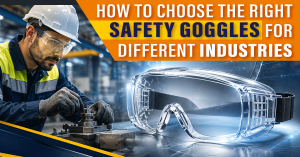
Safety Goggles – PPE worn over the eye to protect the eye. They consist of a rubber eyecup or any type of eye shield.
Looking to understand what safety goggles are?
Another alternative to safety glasses are goggles, which are for eye protection. Safety goggles differ from spectacles as spectacles have a soft rim. This will allow the goggles to fit snugly around your face, thus protecting your eyes. These goggles are another helpful type of eye protection with their hard lenses and soft rubber rims to protect from travel blows, splashes, and dust from all angles.
What is the purpose of wearing safety goggles?
Impact-Resistant Safety Goggles are precisely what you need for the toughest of jobs. Read on to discover why you need these:
- First, they prevent flying debris: Tools can throw objects at a dangerous speed. Goggles can quickly prevent pieces of wood or metal from flying in your eyes.
- Second, they prevent chemical splashes: Our dedicated chemical safety goggles are designed to prevent dangerous liquids or vapours from going into your eyes.
- Third, they exclude dust: When dirty, you don’t want the dust blowing into your eyes through open frames.
- Fourth, they protect from sparks: hot tools shoot bright sparks. Heavy industrial safety goggles are good at fighting the heat.
- They prevent injuries. Most eye injuries are prevented by appropriate equipment.
- And finally, they were able to meet the safety rules: Use the current Green decent work safety goggles; your company will be protected.
Common Workplace Hazards That Require Safety Goggles
Day-to-day eye hazards are present in many jobs. Consequently, glasses are of the utmost importance in these areas:
- Building sites/Exterior works: At building sites, there are flying nails, extremely sharp sand, and heavy dust.
- Factories: Quick machines produce a sudden blast of flying dirt and bits of metal.
- Chemical analysis: Plants often work with toxic liquids.
- Science laboratories: Researchers hold onto dangerous liquids and glassware.
- Woodworkshops: Rapid-cutting saws produce a great amount of dust and spiky wooden splinters.
- Metal working: Cutting steel results in sparks, heat, and bits of steel.
- Health protection: Liquid splashes and germ protection are necessary for doctors.
Key Features of High-Quality Safety Goggles
When shopping for protective safety goggles, you have to search for simple characteristics.
- Impact-resistant lenses: A selection of impact-resistant lens types is available:
- If a lens is robust, then the material is good plastic. Good plastic does not break when struck with force.
- Anti-fog coating: This surface treatment inhibits the formation of aberrating dew.
- Fogging (because of a rapid change of heat) can be a problem when using lenses. Buying anti-fog safety goggles would avoid this.
- Coating which is resistant to scratches
- Scratches impair vision. However, durable covers provide the lenses with long-lasting protection
- Apart from the (however overpriced) insurance of the plant itself, there is the UV protection
- The sun may damage your eyes at outside work. So, a good lens filter blocks dangerous sun rays.
Common Mistakes When Using Safety Goggles
Even good industrial safety goggles bomb if you use them wrong. Avoid these common errors:
- First, wearing the wrong type: Ordinary glasses cannot stop runny splashes like sealed chemical safety goggles.
- Second, choosing a bad fit: Gaps between the frame and your face let dust in fast.
- Third, using scratched lenses: Scratched gear decreases your sight and lower safety.
- Fourth, forgetting to clean: A dirty lens system blurs your sight. So, always keep them spotless with a soft cloth.
- Finally, using old gear: Old malleable gear breaks easily. So, replace broken gear right away.
Conclusion
Eye protection is an essential part of any personal protective equipment (PPE) program and should never be overlooked. High-quality safety goggles provide a secure seal around the eyes, offering reliable protection against impacts, dust, flying debris, and chemical splashes. Features such as anti-fog coatings and scratch-resistant lenses help maintain clear vision, improving both safety and comfort throughout the workday.
To ensure maximum protection, inspect your safety goggles regularly for scratches, cracks, or damaged seals, and replace them when they show signs of wear. Avoid using low-quality or damaged eyewear, as it may fail to provide adequate protection in hazardous environments.
At Protective Wears, we offer premium safety goggles designed to meet demanding workplace safety standards, helping protect workers across industries while ensuring comfort, durability, and long-lasting performance.
Safety Goggles FAQ’s
Should safety glasses be worn?
Yes, safety laws and regulations state that all workers must wear safety goggles if there is a hazard to the eyes, and all employers must provide PPE for all workers.
How durable are safety goggles?
The maximum life for protective eyewear is 1-3 years of use. Repair or replace broken or scratched equipment immediately.